Canonical to CZ decomposer
The canonical to CZ decomposer (Can2CZDecomposer) is a general two-qubit gate decomposer.
When applied to a circuit, it decomposes every two-qubit gate into a sequence of (at most 3) CZ gates
and single-qubit gates.
Unlike the CNOT decomposer and CZ decomposer, the canonical to CZ decomposer is not restricted to controlled two-qubit gates. It can therefore also decompose gates such as the SWAP gate.
Global phase difference
Note that the resulting decomposition using the canonical to CZ decomposer (Can2CZDecomposer)
is equal to the original gate, up to a (possible) difference in global phase.
A difference in global phase can, in certain cases, lead to a semantically different circuit,
therefore we urge the user to be aware of this risk.
The algorithm for the canonical to CZ decomposer is based on the canonical decomposition of an arbitrary two-qubit unitary, as described in Quantum Gates, section 7.3 by G. Crooks (2024).
Any two-qubit unitary \(U\) can be written as,
where \(K_1, K_2, K_3,\) and \(K_4\) are single-qubit unitaries, and where the canonical block \(\text{Can}(t_x,t_y,t_z)\) contains the two-qubit interaction, or entangling, part of the gate. The '\(\simeq\)' symbol is used to denote that the states are equal up to a global phase.
The canonical to CZ decomposer decomposes the canonical block into a set of gates consisting of (at most) 3 CNOTs and single-qubit gates.
The CNOT gates are further decomposed into CZ gates according to the predefined CNOT-to-CZ identity:
where \(c\) and \(t\), respectively represent the control and target qubit:
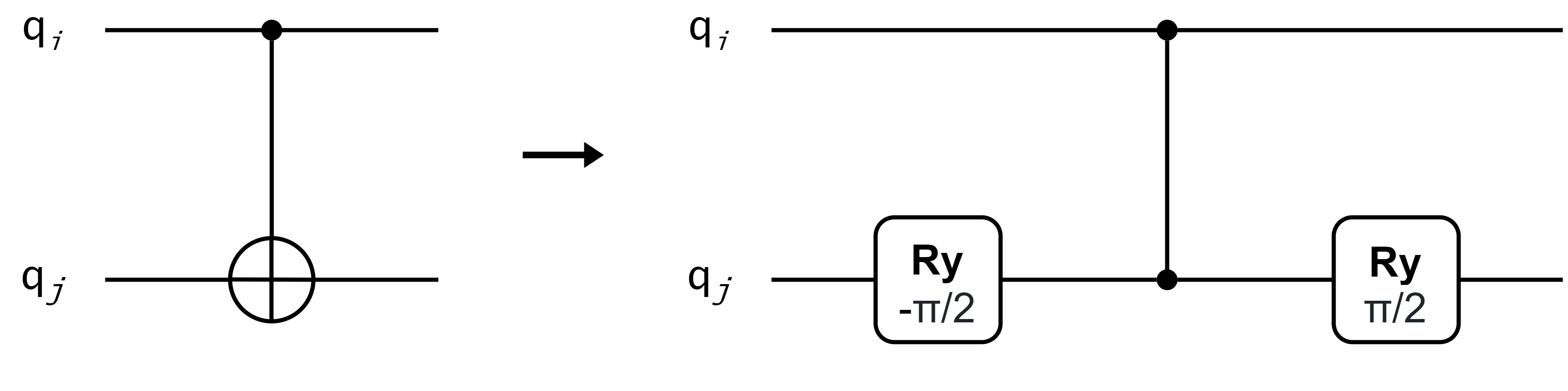
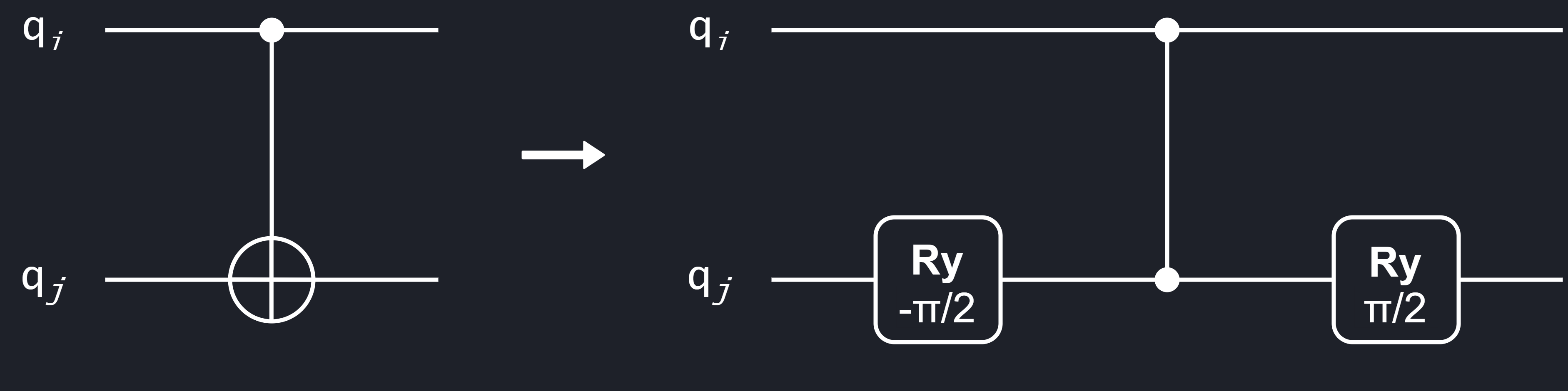
Finally, the resultant decomposition is placed in between the single-qubit \(K\)-rotations.
Decomposition of the canonical block
Depending on the canonical coordinates \((t_x,t_y,t_z)\), the decomposition uses one of three circuit templates, listed below, to create the decomposition.
1. One CNOT gate
For a subset of gates with canonical axis
the decomposition requires only one CNOT gate:


2. Two CNOT gates
For gates with
the decomposition requires two CNOT gates:


3. Three CNOT gates
In the general case, the decomposition requires three CNOT gates:


Note
It is advised to run the single-qubit gates merger
(SingleQubitGatesMerger) after this decomposition pass.