CNOT decomposer
The CNOT decomposer (CNOTDecomposer) is a two-qubit gate decomposer.
When applied to a circuit, it decomposes every controlled two-qubit gate into a sequence of (at most 2) CNOT gates
and single-qubit gates. It decomposes the CR, CRk and CZ controlled two-qubit gates.
The SWAP gate is not decomposed by the CNOT decomposer
The SWAP gate is not a controlled two-qubit gate and can therefore not be decomposed using the CNOT decomposer.
To decompose a SWAP gate into either CNOT or CZ gates,
use the predefined
SWAP to CNOT decomposer (SWAP2CNOTDecomposer)
or SWAP to CZ decomposer (SWAP2CZDecomposer).
Use the more general canoncial gate to CZ decomposer
for a decomposition of any two-qubit gate.
The CNOT gate is, in general, not part of the
primitive gate set of a target backend.
The CZ gate is more likely to be part of the primitive gate set.
After using the CNOT decomposer one could use the
CNOT to CZ decomposer (CNOT2CZDecomposer)
or, instead of using the CNOT decomposer all together, simply decompose the two-qubit controlled gates
using the CZ decomposer.
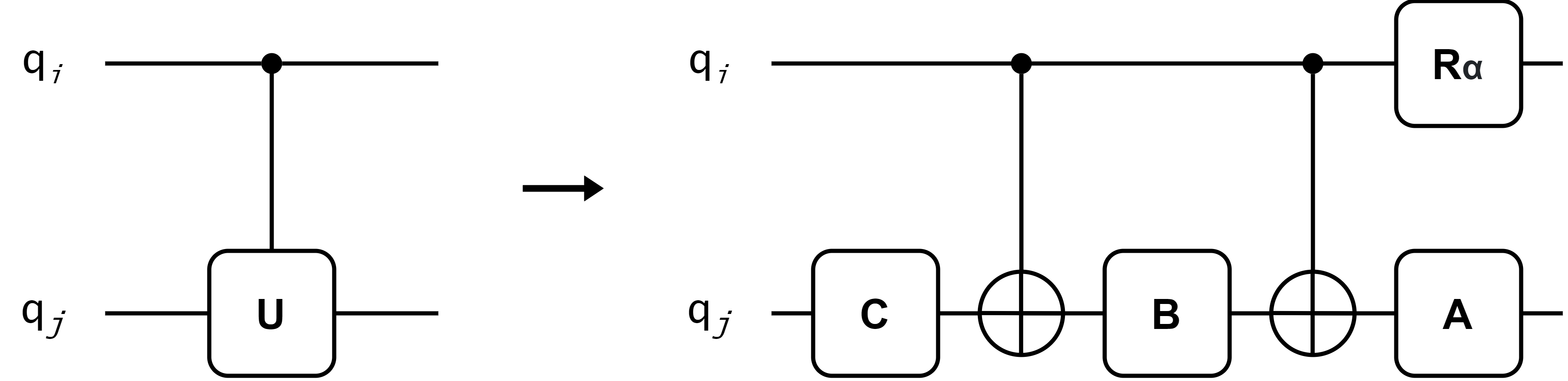
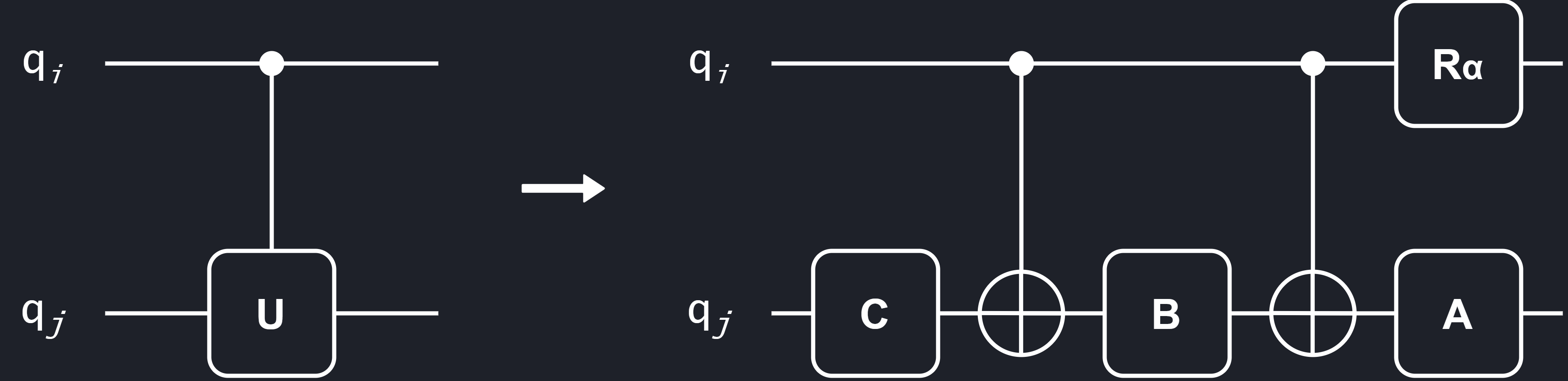
The algorithm for the CNOT decomposer is based on the ABC decomposition (not to be confused with the ABA decomposer). The procedure is described in Quantum Gates, section 7.5 by G. Crooks (2024).
The single-qubit unitary \(U\) of an arbitrary controlled-U gate, can be written as,
where \(\alpha\) denotes a global phase factor, and the single-qubit unitaries \(A\), \(B\), and \(C\), are chosen such that \(A \cdot B \cdot C = I\). In terms of the latter, the decomposition looks as illustrated below:
The ABC decomposition is made using the ABA decomposer,
and in particular, the ZYZ decomposer (ZYZDecomposer),
whereby the arbitary unitary \(U\) is written as,
which can be rearranged such that,
Decomposition using a single CNOT
In certain cases where the unitary \(U\) can be written as
only a single CNOT gate is required in the decomposition, according to Lemma 5.5 in Barenco et al. 1995.